

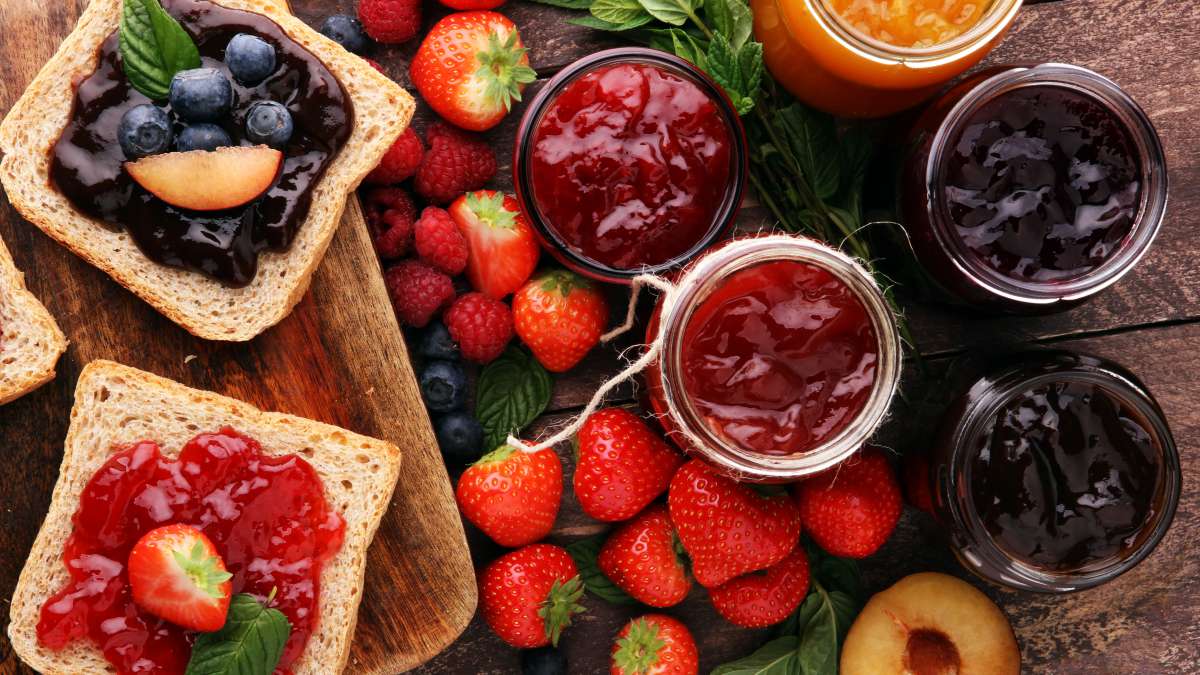
Marmalade? Jam? Jelly? What is the difference?
As a breakfast addition, a little snack in between, or naturally as an accompaniment to tea – jam is an excellent, sweet supplement. With such a rich variety, it is not always easy to make a choice, and the subtle terminological differences between marmalade, jam, and jelly cause confusion as well.
In Austria, we like to group all these diversities under the umbrella term "Marmelade". Other German-speaking countries, such as Germany and Switzerland, differentiate between these sweet spreads somewhat more clearly.
In Switzerland, however, the term "Marmelade" is rarely used; instead, "Konfitüre" (jam) made from real fruit is put on the bread. It may also contain pieces of fruit. A distinction is made, however, from jelly, which does not include any fruit pieces.
Germany uses both terms equally. A distinction is made between "Konfitüre," which always contains pieces of fruit, and "Marmelade," which has no fruit pieces.
Originally in the 80s, the European Community established a clear definition of the individual terms in order to standardize them – although exceptions are not excluded.
The definitions explained in brief:
The various product designations are based on the European Community directive from December 2001.
- The term Marmelade, which is preferred in this country, refers to jams that have a citrus fruit content of at least 20%. It must also be explained what the term "Konfitüre" (jam) is applied to.
- Konfitüre (jam) consists of water, fruit pulp or fruit puree and, of course, sugar, in a ratio that produces the appropriate consistency. It may also contain pieces of fruit.
- Gelee (jelly) differs from both primarily in that it is produced using "aqueous extracts," such as fruit juice, in combination with sugar.
- Konfitüre extra (extra jam) is specifically defined alongside pure jam by a fruit content of at least 45%, except for redcurrants, quinces, rose hips, and sea buckthorn, for which 35% is sufficient.
- Finally, with more than 35% fruit juice, it is called Gelee extra (extra jelly).
The fact that this diversity of officially approved designations confuses consumers is a natural consequence. Fortunately, in everyday language, there are no legal requirements as to how we have to describe the individual spreads.
In 2017, Brexit led Germany to submit an inquiry to the EU Commission as to whether the term "Marmelade" could be expanded again. From the British side, this brazen request was met with stiff rejection and was also not classified as a priority by the Commission and was rejected.
Wilkin & Sons: English Tiptree Jams
 The brand began in 1885 under the name "Britannia Fruit Company" with the goal of producing jam without artificial additives. Behind this was the visionary Arthur Charles Wilkin with two friends. In 1990, after the brand had also gained fame outside of England, it was renamed "Wilkin & Sons." The next milestone came with the appointment as a purveyor to the court, the so-called Royal Warrant Holder, in 1911. Since then, it has been hard to imagine a breakfast table in English households—and many places here as well—without a jar of Wilkin & Sons jam. Northeast of London, at Factory Hill in Colchester, you can visit the Tiptree Jam Museum & Tea Shop.
The various orange marmalades are particularly popular, as there is something for every taste. The spectrum alone ranges from sweet to bitter and everything in between. Tiptree has its own strawberry farm, from which their popular strawberry jams and preserves are created.


Leave a comment
This site is protected by hCaptcha and the hCaptcha Privacy Policy and Terms of Service apply.